20 Kitchen Drawer Storage Ideas for Small Tools
This site contains affiliate links, view the disclosure for more information.
Kitchen drawer storage presents a consistent challenge in most homes. Small tools—peelers, zesters, and herb scissors—lack a fixed home and tend to collect in random piles. Without a deliberate system, drawers become cluttered, and locating specific tools wastes time during meal prep.
Multiple organization methods often work together because kitchens vary in drawer depth, width, and count. A single insert rarely solves every problem. Additionally, tool collections differ from one household to the next, which means one-size solutions typically fall short.
This guide covers 20 practical kitchen drawer storage methods for small tools. It includes expandable dividers, modular inserts, vertical holders, pegboard liners, and specialty organizers. Each method addresses a specific drawer size, tool type, or access pattern.
Expandable Bamboo Drawer Dividers for Kitchen Drawer Storage
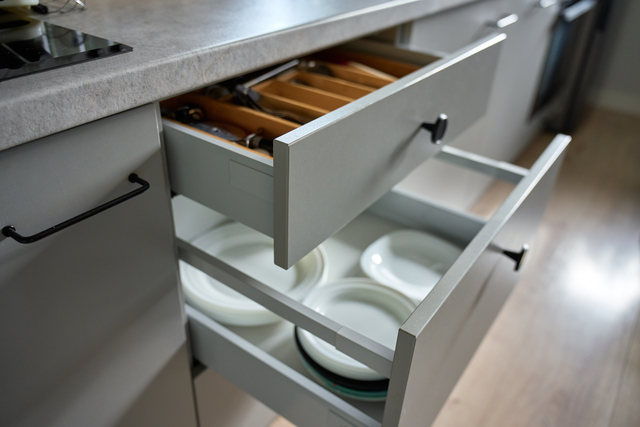
Expandable bamboo dividers create fixed lanes inside a drawer. They adjust horizontally to fit drawers ranging from roughly 12 to 24 inches wide. Most dividers hold tension against drawer walls without hardware.
Each lane separates one category of tools. For example, whisks occupy one lane while spatulas occupy another. Bamboo resists moisture better than untreated wood and typically lasts several years with minimal maintenance.
- Fits standard drawer widths between 12 and 24 inches
- Adjusts without tools
- Works on flat drawer bottoms only
Dividers do not contain depth. Tools taller than the divider rail can tip over and cross into adjacent lanes.
Stackable Plastic Drawer Organizer Trays
Stackable plastic trays slot together inside a drawer to form a grid. Each tray holds a specific tool category. Additionally, modular designs allow users to rearrange compartments as their tool collection changes.
Trays typically come in sets of four to eight pieces. Compartment sizes range from small (for bottle openers and corn holders) to large (for ladles and tongs). Because plastic surfaces wipe clean easily, these trays suit high-use drawers near the stove.
- Modular and rearrangeable
- Dishwasher-safe in most brands
- Lightweight and inexpensive
Stacking height limits apply. Some drawer styles have a minimum clearance that prevents a second tray layer from fitting beneath the drawer above.
Foam Drawer Liner with Custom Tool Cutouts
Foam liners with precut or custom-cut slots hold each tool in a fixed position. However, this method requires knowing which tools will occupy the drawer permanently. Foam sheets cut with a craft knife or scissors to match tool outlines.
Each tool rests in its designated cutout, preventing movement during drawer operation. This method suits knife roll alternatives, small measuring spoons, and precision baking tools. Similarly, toolbox foam liner techniques translate directly to kitchen use.
- Prevents tool shifting
- Absorbs impact and reduces noise
- Compatible with any drawer depth
Cutouts become obsolete when tool collections change. Recutting foam takes time and wastes material if done repeatedly.
Utensil Tray Inserts with Fixed Grid Compartments
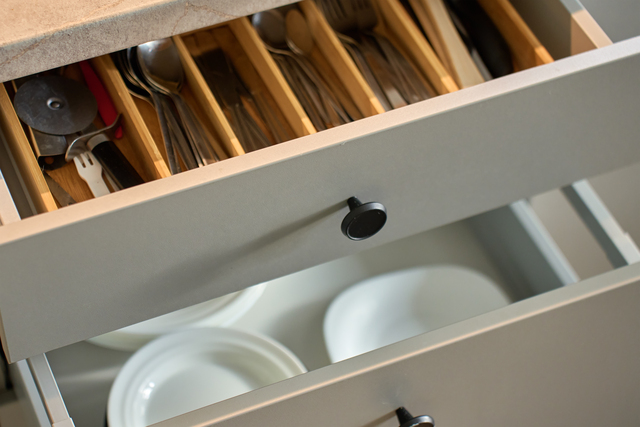
Fixed-grid utensil trays divide a drawer into predetermined sections. These inserts typically measure the full width and depth of standard 18- or 24-inch drawers. Because compartment sizes remain fixed, users sort tools into the closest-fitting section.
Trays made from stainless steel or hard plastic stay rigid under weight. Therefore, heavier tools like meat mallets or large can openers sit flat without warping the insert. Most fixed trays come in white, gray, or silver to blend with cabinet interiors.
- Available in standard drawer dimensions
- Rigid under load
- Easy to remove for cleaning
Fixed grids cannot adapt to non-standard drawer sizes. Gaps around the edges collect crumbs if the tray does not fit the drawer precisely.
Pegboard Drawer Liner for Flexible Tool Placement
Pegboard liners sit flat inside a drawer and accept small pegs or hooks. Each peg anchors into a hole and holds one tool in place. As a result, tool positions shift without cutting or permanent modification.
Standard pegboard hole spacing measures one inch on center. This spacing accommodates most small tool handles. Also, pegboard liners work well inside deep drawers where tools would otherwise pile on top of each other.
- Repositionable peg system
- Compatible with hooks, loops, and clips
- Works in drawers at least 2.5 inches deep
Pegboard liners add height to the drawer floor. This reduces usable drawer depth by approximately half an inch, which can create clearance issues with very shallow drawers.
Magnetic Strip Liner Inside Deep Drawers
Magnetic strip liners mount flat along the interior base of a drawer. Ferrous metal tools—knife sets, spice jar lids, metal measuring spoons—attach directly to the surface. However, this method only works with tools that contain iron or steel.
Magnetic strips typically attach with adhesive backing or small screws. They hold tools securely even when drawers open and close quickly. Additionally, magnetic surfaces keep tools visible and separated, which reduces search time.
- Holds ferrous tools securely
- Prevents tool-to-tool contact and scratching
- Compatible with deep or shallow drawers
Do not store knives blade-down on a magnetic liner without a protective sleeve. Unprotected blade contact with hard magnetic surfaces can dull edges over time.
Read More: How to Organize Kitchen Drawers in Small Apartments
Adjustable Drawer Inserts for Kitchen Drawer Storage of Bulky Tools
Adjustable inserts with deep, wide compartments accommodate larger small tools like ladles, slotted spoons, and potato mashers. These inserts typically use sliding dividers rather than fixed walls. Therefore, compartment width adjusts to match tool dimensions.
Deep compartments generally measure three to four inches in depth. This allows taller tools to stand at an angle without falling flat. Because these inserts expand or contract, they suit drawers of varying widths.
- Sliding dividers adjust to tool size
- Suitable for bulky, long-handled tools
- Typically fits drawers 18 to 30 inches wide
Adjustable dividers require periodic re-tightening as they loosen with repeated drawer use.
Vertical Slotted Organizer for Flat Tool Storage
Vertical slotted organizers hold flat tools—spatulas, fish turners, pancake flippers—in upright position within a drawer. Each slot fits one tool handle. Also, vertical storage exposes tool heads fully, allowing quick visual identification.
Slot spacing typically measures 0.75 to 1.5 inches apart. This range accommodates both narrow and wide handles. Vertical organizers work best in drawers at least four inches deep to support full tool height without tipping.
- Keeps flat tools separated and upright
- Reduces horizontal footprint
- Works well for tools with uniform handle thickness
Slotted organizers do not suit tools with wide or irregular handle bases, as those bases prevent full seating into the slot.
Soft Silicone Drawer Organizer for Delicate Tools
Soft silicone organizers cushion delicate tools like zesters, channel knives, and specialty peelers. Silicone grips tool surfaces lightly and prevents sliding. Additionally, silicone mats remain flexible and cut to custom dimensions with kitchen scissors.
Most silicone organizers come in neutral colors and fit standard drawer sizes. They tolerate heat, cold, and moisture without degrading. Because silicone does not absorb odors, these organizers suit spice-adjacent drawers.
- Flexible and customizable
- Heat- and moisture-resistant
- Non-slip surface keeps tools stationary
Silicone organizers lack rigid walls. Without dividers, tool categories mix together unless users separate them with additional inserts.
Sliding Drawer Insert Trays for Two-Zone Organization
Sliding insert trays stack vertically inside a deep drawer and pull forward independently. The front tray slides out to reveal a second tray beneath. Therefore, two layers of tools fit in a single drawer without permanent modification.
Front tray space works well for frequently used tools. Rear tray space stores seasonal or rarely used items. This method typically requires a drawer at least five inches deep to accommodate both trays plus clearance.
- Doubles drawer storage capacity
- No installation required in most designs
- Compatible with deep base cabinet drawers
Sliding trays add friction to drawer operation over time. Debris between tray and drawer bottom also causes sliding resistance.
Repurposed Ice Cube Tray for Tiny Tool Compartments
Ice cube trays provide small, uniform compartments for tiny tools. Corn holders, cocktail picks, twist ties, and bag clips fit neatly into each cell. However, this method suits only the smallest kitchen tools.
Standard ice trays fit inside most 18-inch drawers without cutting or modification. Also, silicone ice trays flex to fit non-standard drawer widths. Because trays come in many grid sizes, users can match cell dimensions to specific tool categories.
- Free or very low cost
- Available in standard and custom cell sizes
- Easy to clean
Ice cube trays lack stability. They shift inside a drawer unless secured against a wall or placed inside a larger tray.
Labeled Section Dividers for Category-Based Kitchen Drawer Storage
Labeled section dividers combine physical separation with visual identification. Each divider marks one category—cutting tools, measuring tools, opening tools. As a result, household members without organizational familiarity can locate and return tools correctly.
Labels typically attach with adhesive or sit in a slot on the divider frame. Printed or handwritten labels both function equally well. Similarly, labels reduce the chance of tools migrating into the wrong category over time.
- Reduces search time for all users
- Compatible with most divider systems
- Supports consistent organization maintenance
Labels detach from smooth drawer surfaces over time in humid environments. Choosing labels rated for moisture exposure extends their lifespan.
Tension Rod Grid for Lid and Flat Tool Control
Tension rods install horizontally inside a drawer and create a grid when placed in parallel. Flat tools rest vertically between rods. Also, tension rods separate cutting boards, pot lids, and large spatulas without any hardware.
Standard tension rods adjust from 12 to 20 inches in length. They hold tension against drawer walls and remove without tools. Because rods sit above the drawer floor, small items can still occupy the space underneath.
- No installation hardware required
- Adjustable to drawer width
- Easily repositioned
Tension rods holding heavy items can slip sideways over time as tension decreases. Periodic re-tightening maintains rod position.
Knife Wrap Insert for Drawer-Based Blade Storage
Knife wrap inserts protect blade edges and separate knives stored flat inside a drawer. Each wrap holds one knife in a fabric or synthetic sheath. Additionally, inserts prevent knives from contacting other tools, which extends edge life.
Always use a dedicated knife insert or individual sheaths when storing knives in a mixed-tool drawer. Loose blades in drawers cause injury during unguarded access.
Knife inserts typically hold three to eight knives depending on blade width. They sit flat and occupy roughly one-third of a standard drawer.
- Protects blade edges
- Prevents accidental cuts during access
- Compatible with standard and wide drawers
Knife inserts require sufficient drawer depth to hold blades flat without bending handles upward.
Related Post: How to Organize Kitchen Drawers Without Dividers
Custom-Cut Craft Foam Liners for Measuring Spoon Sets
Custom-cut craft foam liners hold measuring spoon sets in fixed slots. Each spoon rests in a slot sized to its handle diameter. Therefore, spoons stay separated and avoid tangling, which is a common problem with ring-attached sets.
Craft foam costs little and cuts with household scissors. A single foam sheet typically covers one standard drawer. Also, foam liners muffle sound when drawers close quickly.
- Inexpensive and widely available
- Customizable to any spoon size
- Reusable with minor reshaping
Craft foam compresses over time under heavy tools. Compressing reduces slot definition and allows tools to shift.
Modular Interlocking Drawer Bins for Specialty Tool Kits
Interlocking bins connect side-by-side inside a drawer to form a custom grid. Each bin holds one specialty tool category, such as pastry tools, thermometers, or citrus accessories. Additionally, interlocking designs prevent bins from sliding independently.
Bin depth typically ranges from 1.5 to 3 inches. This range suits most small-to-medium kitchen tools. Because bins connect without adhesive, users reconfigure the layout without residue.
- Configurable without adhesive
- Available in multiple depths
- Compatible with most standard drawer widths
Interlocking bins require a minimum drawer width to allow a full row of connected units. Drawers narrower than 12 inches may not accommodate a full interlocking set.
Drawer-Within-Drawer Insert for Deep Cabinet Drawers
Drawer-within-drawer systems install a smaller sliding tray above the main drawer floor. The inner tray handles frequently used tools while the space below stores larger, less-used items. Therefore, one deep drawer functions as two accessible storage zones.
These systems require a minimum drawer depth of five to six inches. Installation typically involves adhesive mounting strips along drawer walls. Also, most systems support loads up to five to eight pounds in the inner tray.
- Maximizes deep drawer utility
- Separates daily-use from occasional-use tools
- Available in several width sizes
Inner tray weight limits prevent storing heavy tools such as cast iron presses or large meat tenderizers in the upper zone.
Read More:
- 15 Pot Lid Storage Solutions for Standard Cabinets
- 18 Pantry Storage Ideas for Narrow Spaces That Feel Small
- 14 Ways to Organize Open Shelves in the Kitchen
- 21 Ways to Organize a Small Kitchen on a Budget
Silicone Grip Mat Liner for Anti-Slip Tool Placement
Silicone grip mats line the drawer floor and prevent tools from sliding during drawer movement. They do not create separate compartments but stabilize unorganized tool placement. However, grip mats work best as a foundation layer beneath other organizers.
Standard grip mats cut to any dimension with scissors. They also cushion tool impact and protect drawer finish from scratches. Because mats require no adhesive, they remove and wash easily.
- Non-slip surface reduces tool movement
- Protects drawer interior from scratch damage
- Compatible with all tool sizes and types
Grip mats do not organize. Users must add dividers or trays on top to maintain category separation.
Drawer Organizer Inserts Designed for Baking Tool Storage
Baking-specific inserts hold pastry brushes, dough scrapers, bench knives, and decorating tips in separated compartments. These inserts typically feature narrow vertical slots and small round cups for piping tips. Additionally, baking tool inserts often come in white or clear to match baking-adjacent cabinet aesthetics.
Most baking inserts measure between 12 and 18 inches wide. Compartments include both horizontal slots and vertical pockets to handle tools of varied shapes. Because baking tools often have delicate tips, padded or silicone-lined compartments protect tool edges.
- Designed for varied baking tool shapes
- Includes small-diameter compartments for tips and attachments
- Compatible with standard kitchen drawers
Baking inserts typically do not accommodate general cooking tools well. Using them in mixed-tool drawers leaves large compartments underused.
Pull-Out Drawer Insert for Corner Cabinet Tool Storage
Pull-out inserts install inside corner or deep cabinet drawers and extend outward on a sliding rail. Users access tools at the front without reaching into the back of the drawer. Therefore, this system suits base cabinets with drawers deeper than 20 inches.
Installation requires mounting the rail along the drawer side. Also, most pull-out inserts support loads between 15 and 25 pounds depending on rail rating. Inserts typically come in widths from 9 to 18 inches.
- Eliminates blind-reach into deep drawers
- Rated for moderate tool weight
- Compatible with most base cabinet configurations
Follow manufacturer load ratings strictly. Overloading a pull-out rail causes rail failure and potential drawer collapse.
For more helpful tips, check out our storage section.