13 Simple Kitchen Counter Organization Ideas for Cooking Essentials
This site contains affiliate links, view the disclosure for more information.
Kitchen counter organization is a common challenge, especially in smaller kitchens where every inch of surface space matters. Counters tend to accumulate appliances, utensils, and ingredients without much of a system, which leaves less room for actual meal prep. The right storage approach depends on what you cook most and how your kitchen is laid out.
No single solution works for every counter. A household that uses a coffee maker, knife block, and fruit bowl daily needs a different setup than one that keeps the counter mostly clear. Because cooking essentials vary by household, most kitchens benefit from a combination of two or three organization methods rather than one.
This guide covers thirteen practical ways to organize kitchen counters, including vertical storage, container systems, mounted options, and space-saving racks. All methods focus on the countertop surface and the everyday cooking items that tend to live there.
- Most counters need more than one type of organizer to handle different item categories
- Vertical and corner solutions can recover space without adding footprint
- Measuring counter depth before buying any riser or rack prevents sizing issues
- Matching container sets reduce visual clutter even in smaller kitchens
Utensil Crocks Keep Cooking Tools Within Reach
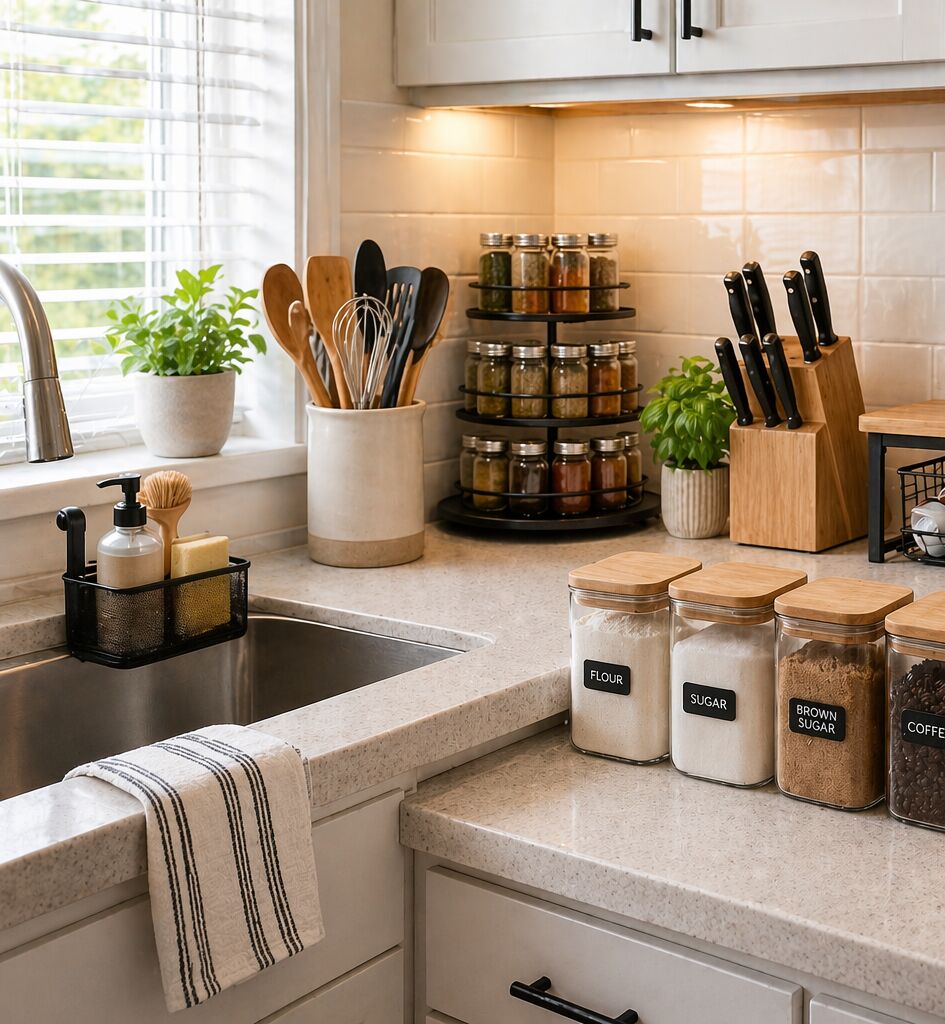
A countertop utensil crock holds spatulas, spoons, and tongs upright near the stove. Ceramic and stainless steel versions are widely available and typically priced affordably at most home stores. Wide-mouth crocks tend to work better than narrow ones because they reduce crowding and tipping.
Some cooks keep two crocks to separate heat-safe tools from serving utensils. However, crocks holding more than eight to ten tools become difficult to navigate during cooking.


Tiered Spice Racks Make Good Use of Corner Space
Corner counter areas often go unused because standard organizers do not fit angular spaces well. A tiered corner spice rack fits into that dead zone and keeps jars visible without opening a cabinet. Rotating versions spin to bring back-row jars forward, which helps on deeper counters.
These racks typically hold between twelve and thirty jars depending on tier count. They work less well when placed directly beside a stove, since heat and steam can affect labels and some spice flavors over time.
Knife Blocks Free Up Drawer Space
A countertop knife block keeps blades accessible and protects edges better than storing knives loose in a drawer. Universal bristle-style blocks accept knives of any shape or size, which makes them more flexible than traditional slotted versions. Additionally, they are widely available online and in home goods stores.
Keep knife blocks away from the stove and sink area to reduce heat and moisture exposure to handles and blades.
Bristle blocks do require occasional cleaning to prevent buildup between the bristles.
Also Read: 12 Space-Saving Laundry Shelf Storage Ideas for Small Spaces
Riser Shelves Work Well for Coffee Stations
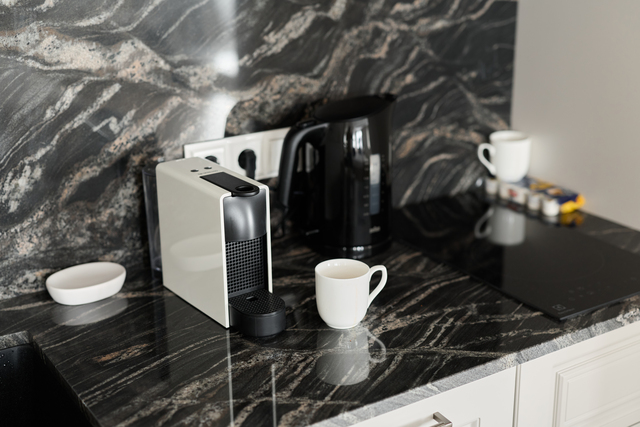
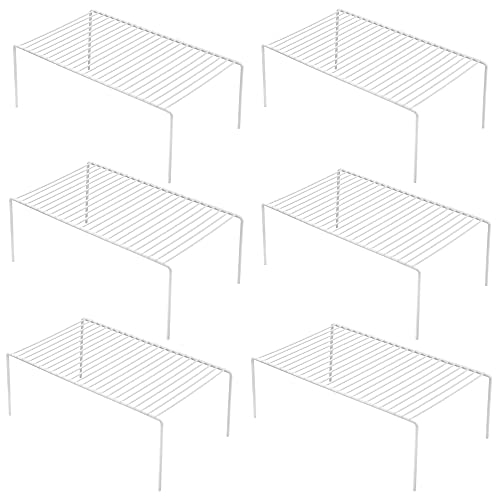
A riser shelf lifts a coffee maker or mugs to create usable space underneath for pods, filters, or a small tray. Because risers add a second level, they allow one counter section to hold more without spreading outward. Bamboo and wood versions are sold in single and double-tier options at most home goods stores.
Risers with legs shorter than three inches typically do not leave enough clearance underneath to be practical. This setup generally works best on counters at least eighteen inches deep.
Stackable Produce Baskets Organize Fruit and Vegetables
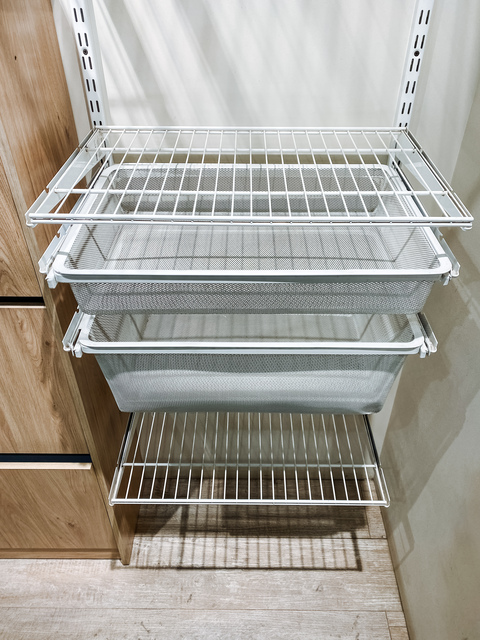
Produce stored on the counter needs airflow rather than an enclosed container. Stackable wire or mesh produce baskets allow air to circulate while keeping fruit and vegetables sorted by type. Additionally, stacking vertically uses counter height rather than spreading across the surface.
These typically come in sets of two to four tiers. However, deep baskets can trap smaller items at the bottom where they are easy to overlook.
Read More: 8 Easy Kitchen Cabinet Organization Ideas For Better Flow
Airtight Canister Sets Contain Dry Goods Neatly
Some kitchens keep frequently used dry goods — flour, sugar, coffee — in open containers on the counter rather than in the pantry. A matching set of airtight canisters keeps these items fresh and reduces the cluttered look that mismatched containers create. Square or rectangular canisters sit flush against each other and use space more efficiently than round ones.
Sets of four to eight pieces are sold in glass, ceramic, and stainless steel at most home goods stores. Round canisters leave gap space between units that collects crumbs and is harder to clean.

Over-the-Sink Caddies Move Dish Supplies Off the Counter
Dish soap, sponges, and scrubbers often cluster at the sink edge and reduce usable counter space nearby. An over-the-sink caddy holds these items above the basin instead. Because it repositions items over the sink, it also reduces water drips on the surrounding counter surface.
Check weight limits on adhesive versions before storing heavy soap dispensers or bottles.
These caddies require a recessed sink with a lip — they do not work with flush-mounted sinks.
Magnetic Spice Tins Use Refrigerator Surface Instead of Counter
Magnetic spice tins attach to the side panel of a refrigerator, which removes spice jars from the counter entirely. Sets typically include twelve to twenty-four tins and are available in clear-lid versions that make contents easy to identify. Similarly, this approach works well in kitchens where counter space near the stove is limited.
This method only works on magnetic refrigerator surfaces. Stainless steel panels with non-magnetic finishes will not hold the tins.
Countertop Lid Racks Keep Pot Lids Off the Counter
Pot lids without dedicated storage tend to pile up on the counter or get stacked inside pots in the cabinet. A countertop lid rack holds lids vertically in individual slots, which makes each lid visible and easy to grab. Adjustable-slot versions accommodate lids ranging from eight to twelve inches in diameter.
Most racks hold between three and six lids. Racks holding more than four can become wide enough to crowd a standard counter run.
Also Read: 16 Simple Linen Closet Organization Ideas for Easy Access
Paper Towel Holders Mount Under Cabinets to Save Surface Space
A freestanding paper towel holder takes up a small but consistent footprint on the counter. Mounting one to the underside of a cabinet removes it from the surface entirely. Because under-cabinet versions use vertical space, they free the counter below for prep work.
Adhesive mount versions work on most cabinet surfaces but may not hold well in high-moisture areas near the sink. Screw-mount versions provide more stability for heavier rolls.

Shallow Trays Corral Small Miscellaneous Items
Some kitchens lack enough drawer space, which pushes small items — twist ties, rubber bands, spare batteries — onto the counter. A shallow countertop tray with dividers keeps these items contained in one spot rather than scattered. Additionally, trays with removable dividers can reconfigure as storage needs change.
Expandable bamboo divider trays placed on the counter work the same way as a built-in drawer organizer. However, this method suits items used less frequently — high-use tools belong in a crock or rack for faster access.
Appliance Garages Conceal Small Appliances
An appliance garage is a cabinet-style enclosure that sits on the counter and hides items like toasters and coffee makers when not in use. It can reduce visual clutter in kitchens where multiple small appliances share the same counter zone. However, appliance garages require at least twelve inches of counter depth and adequate height clearance for taller items.
Confirm that any enclosed appliance garage provides sufficient ventilation before storing heat-generating appliances inside.
Recipe Stands Keep Books Off the Prep Surface
A countertop recipe stand holds a cookbook at eye level during cooking. Because it props items vertically, it frees the flat surface below for actual prep work. Fold-flat versions store in a drawer when not in use, which makes them practical for kitchens with limited counter space.
Stands with a wide base can interfere with prep if placed in the center of the counter rather than toward the back edge.
For more ideas, check out our organization category.