21 Kitchen Drawer Organization Ideas for Utensils and Gadgets
This site contains affiliate links, view the disclosure for more information.
Kitchen drawer organization is one of the most common friction points in home management. Drawers accumulate utensils, gadgets, and tools at different rates, making it difficult to maintain a consistent system. Mismatched items, varying sizes, and limited drawer depth all contribute to disorganization over time.
Multiple organization systems are necessary because no single product fits every drawer type. A deep gadget drawer requires different solutions than a narrow utensil drawer. Drawer dimensions, cabinet configuration, and item frequency of use all affect which methods work.
This guide covers 21 practical kitchen drawer organization methods, including dividers, inserts, vertical storage tools, stackable trays, and label-based systems. Methods are grouped by storage category, not by difficulty or sequence.
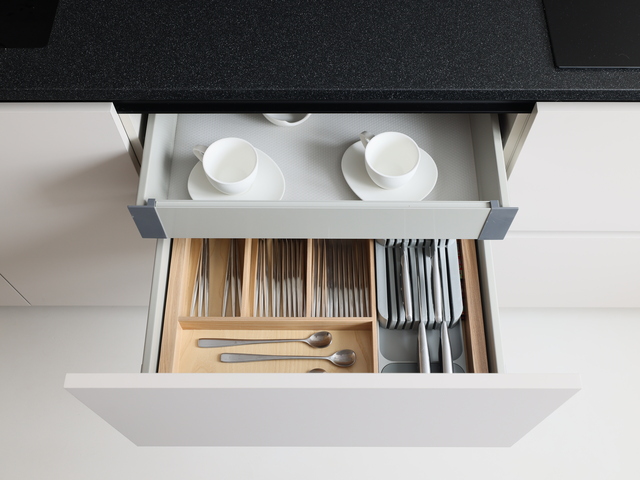
Expandable Drawer Dividers for Kitchen Drawer Organization
Expandable dividers create adjustable sections within a single drawer. They fit most standard drawer widths without tools or adhesives.
- Typical width range: 12–21 inches
- Material: Bamboo, plastic, or coated metal
- Depth compatibility: Works best in drawers 2.5 inches or deeper
Dividers do not work in drawers with internal frame obstructions or non-rectangular interiors.
Fixed-Grid Drawer Inserts
Fixed-grid inserts are pre-formed trays with uniform compartments. They are available in standard kitchen drawer sizes and designed for utensils, measuring spoons, and small tools.
Grids do not adjust to accommodate oversized items. They are best suited for drawers with a consistent item inventory.
Custom-Cut Foam Inserts
Foam inserts are cut to match the exact shape of specific items. They are commonly used for knife sets, specialty gadgets, or fragile tools.
- Material: Polyethylene or EVA foam
- Thickness: Typically 1–2 inches
- Custom cutting: Manual or die-cut
Foam degrades with prolonged moisture exposure. It should not be used in drawers near the sink without a moisture barrier.
Bamboo Drawer Organizer Trays
Bamboo trays are rigid, modular organizers placed inside drawers. They are available in multiple sizes and can be combined to fill irregular drawer dimensions.
Bamboo expands slightly with humidity. In high-moisture kitchens, gaps between trays may widen or tighten seasonally.
Stackable Organizer Trays for Deep Drawers
Kitchen drawer organization in deep drawers often requires a two-layer approach. Stackable trays use a lift-out top layer to access items stored below.
- Top layer: Frequently used utensils
- Bottom layer: Occasional-use gadgets or backup items
- Weight limit: Typically 5–8 lbs per tray
Stacking is only functional when the drawer depth exceeds 4 inches.
Read More: 16 Bathroom Drawer Organization Ideas for Small Items
Utensil Holders Inside Drawers
Horizontal utensil holders keep long-handled items separated and flat. They are typically slotted or channeled to prevent rolling.
These holders are designed for spatulas, ladles, and tongs. They are not suitable for drawers under 18 inches wide when more than six items are stored.
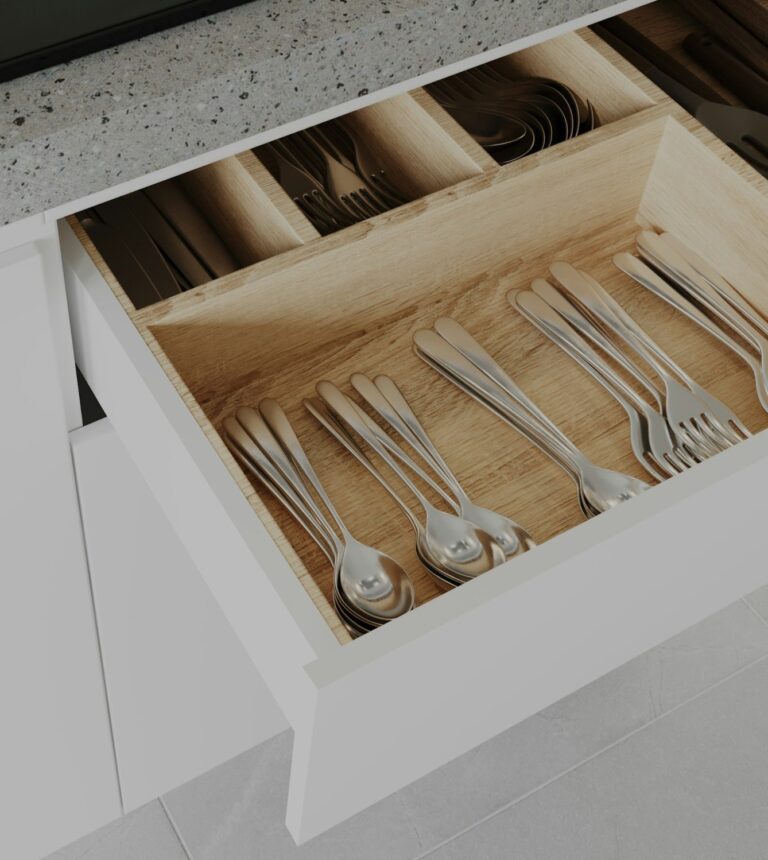
Cutlery Trays for Flatware Organization
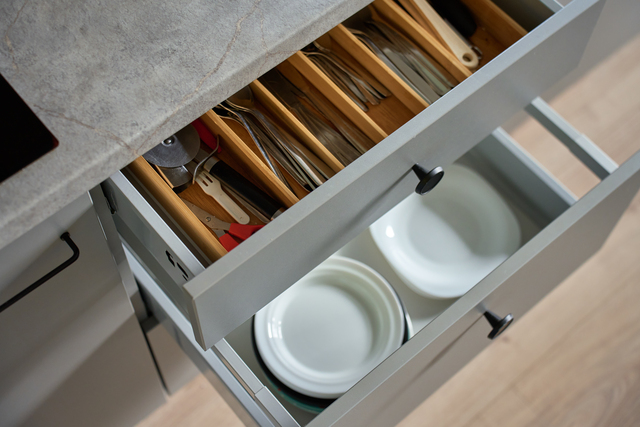
Cutlery trays are purpose-built for forks, knives, and spoons. They include narrow slots sized to standard flatware dimensions.
Most cutlery trays are not compatible with oversized serving utensils. A separate tray or divider section is required for those items.
Knife Drawer Inserts
Safety Note
Knife inserts must be used only in drawers where the blade is fully sheathed or slotted. Loose knife storage in standard inserts is a cut hazard.
Knife drawer inserts use individual slots angled to protect blade edges. They are typically made from wood or high-density foam.
- Slot count: 6–12 knives depending on model
- Compatible blade lengths: Up to 10 inches in most standard inserts
Inserts with a fixed slot width do not accommodate thick-spined blades like cleavers.
Also Read: 18 Ways to Organize Under-Sink Bathroom Storage
Peg-Style Drawer Organizers
Peg organizers use a grid base with removable pegs to create custom compartments. They are highly adaptable to changing storage needs.
Peg systems require a minimum drawer depth of 2 inches for the base. Compartment walls formed by pegs are not rigid and may shift under heavy item weight.
Vertical Dividers for Baking Sheet and Cutting Board Drawers
Vertical dividers stand upright inside a drawer to separate flat items. They are used for cutting boards, baking mats, lids, and sheet pans stored on edge.
- Divider height: Must match drawer interior height exactly
- Material: Metal, plastic, or coated wood
- Spacing: Adjustable in 1–2 inch increments on most models
Vertical dividers require a drawer depth of at least 10 inches for full-size cutting boards.
Pull-Out Drawer Inserts for Lower Cabinet Drawers
Pull-out inserts are mounted inside deep lower cabinet drawers on a sliding mechanism. They allow access to items at the back without fully opening the drawer.
These inserts require screw mounting to the drawer floor. They are not compatible with drawers that use a full-extension undermount slide system without modification.
Spice Drawer Inserts
Spice drawer inserts hold spice jars horizontally at a slight angle for label visibility. They are designed specifically for standard spice jar diameters.
Compatible Jar Sizes
- Standard spice jars: 1.5–2 inch diameter
- Tall spice jars: Up to 3.5 inches in height
Non-standard or wide-mouth jars do not fit most pre-sized inserts.
Wrap and Foil Organizers for Narrow Drawers
Kitchen drawer organization in narrow drawers benefits from dedicated wrap organizers. These holders keep plastic wrap, foil, and parchment rolls upright and separated.
- Minimum drawer width: 10 inches
- Roll capacity: Typically 3–5 standard rolls
Most models do not accommodate jumbo or commercial-size rolls.
Small Parts Trays for Gadget Drawers
Small parts trays use multiple tiny compartments for loose items like twist ties, bag clips, and jar openers. They are rigid and do not flex under normal kitchen use.
Trays with compartments under 1.5 inches square are not practical for bulky gadgets. A separate tray with larger cells is required for those items.
Read More:
- 15 Pot Lid Storage Solutions for Standard Cabinets
- 18 Pantry Storage Ideas for Narrow Spaces That Feel Small
- 14 Ways to Organize Open Shelves in the Kitchen
- 21 Ways to Organize a Small Kitchen on a Budget
Magnetic Knife Drawer Strips
Magnetic strips installed inside a drawer hold knife blades securely against a flat surface. They are an alternative to slotted knife inserts.
Magnetic strips must be rated for kitchen knife weight. Strips not rated for metal tool weight can release blades unexpectedly.
They are not recommended in drawers where non-magnetic stainless steel knives are used, as these will not adhere.
Label-Based Zoning Without Physical Dividers
Label-based zoning assigns fixed locations for item categories without physical separators. Labels are applied to the drawer floor or front edge.
This method works only in low-traffic drawers or with highly disciplined household use. It provides no physical boundary to prevent item migration.
Adjustable Tension Rod Dividers
Tension rods installed horizontally across a drawer create a low-profile barrier between item groups. They require no tools and leave no marks.
- Compatible drawer width: 12–30 inches depending on rod length
- Load capacity: Light items only — loose utensils, bags, or linens
Tension rods are not stable enough to separate heavy gadgets or dense utensil collections.
Interlocking Modular Bins
Modular bins use a clip or friction-fit connection to stay aligned inside a drawer. Individual bins can be rearranged as storage needs change.
Bin walls are typically 2–3 inches tall. They do not contain items that exceed bin wall height when the drawer is closed.
Deep Drawer Organizers for Gadget Storage
Deep drawer organizers are tall-walled bins designed for bulky kitchen gadgets. They are used for items like potato mashers, whisks, and peelers stored lying flat.
These organizers require a minimum interior drawer depth of 5 inches. They do not accommodate items with handles longer than the bin’s interior length.
Related Post: How to Organize Kitchen Drawers Without Dividers
Tray Liners for Drawer Floor Protection
Drawer liners protect the interior surface and reduce sliding. They are available in non-adhesive, adhesive, and grip-texture varieties.
- Material: Cork, rubber, vinyl, or foam
- Thickness: 1–4mm depending on type
- Adhesive versions: Not recommended in rental properties or on unfinished wood
Liners do not provide structural organization. They function only as a secondary surface layer beneath existing organizers.
Under-Drawer Mounted Rail Systems
Rail systems mount to the underside of upper cabinet sections and hold shallow bins or rails at drawer height. They extend usable storage to areas without actual drawers.
These systems require a minimum of 3 inches of clearance beneath the upper cabinet shelf. Load limits are typically 10–15 lbs per rail section, and exceeding this limit risks bracket failure.
For more helpful tips, check out our organization section.