20 Kitchen Utility Drawer Organization Ideas
This site contains affiliate links, view the disclosure for more information.
A kitchen utility drawer quickly becomes the default home for everything without a clear storage spot. Batteries, twist ties, takeout menus, rubber bands, and random hardware accumulate fast. Without a dedicated system, the drawer turns difficult to search and easy to overfill. Effective kitchen utility drawer organization starts with recognizing that the problem exists before a solution can work.
Most households need more than one method to handle kitchen utility drawer organization properly. A single insert rarely addresses the variety of item sizes and categories a junk drawer holds. Additionally, dividers, small bins, and label systems often need to work together to keep contents accessible and sorted. Because item types vary so widely, a one-size solution typically falls short.
This guide covers 20 practical kitchen utility drawer organization methods for every household type. The approaches include modular dividers, container systems, label strategies, vertical organizers, and category-based sorting techniques. Furthermore, each method suits different drawer sizes, item types, and household needs.
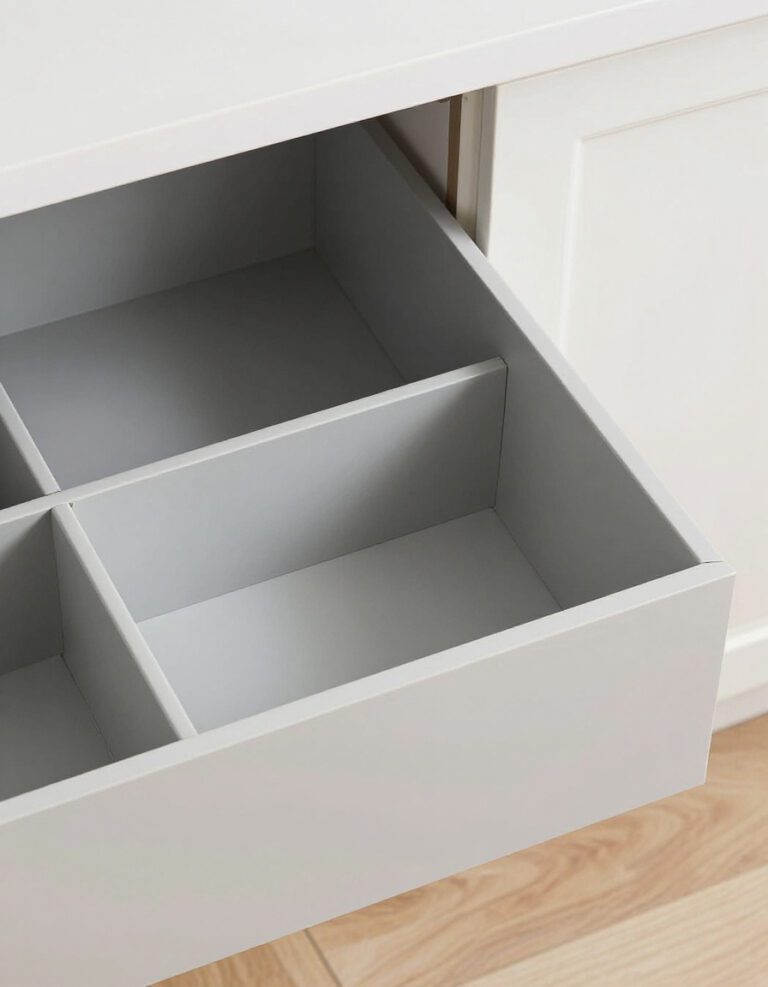
Adjustable Drawer Dividers for Kitchen Utility Drawer Organization
Adjustable dividers create customizable sections without requiring tools or adhesives. They expand to fit the drawer’s interior width, and repositioning them requires no special effort as storage needs change. Most manufacturers make them from plastic, bamboo, or coated metal.
- Available in sets of 3–8 dividers per pack
- Typically fit drawers 12–24 inches wide
- Reposition without damage to the drawer
Adjustable dividers perform best in standard-depth drawers. However, they may not hold firmly in very shallow drawers or in drawers with uneven interior walls.
Small Bins and Containers for Sorting Drawer Contents
Small bins group similar items into dedicated zones within the drawer. They also prevent loose items from shifting when the drawer opens and closes. Bins with flat bases and low walls offer the easiest access.
Common bin materials include clear plastic, silicone, and bamboo. Clear bins allow visual identification without removing items. In contrast, silicone bins offer flexibility and compress to fit tightly into irregular spaces.
Bins must match the drawer’s interior depth. Containers that are too tall will prevent the drawer from closing fully.
Stackable Mini Trays for Maximizing Vertical Space
Stackable trays add a second storage layer in deeper drawers. The lower tray typically holds flat or rarely used items, while the upper tray remains accessible for frequently reached items. As a result, this system doubles the drawer’s functional capacity.
- Best suited for drawers at least 3 inches deep
- Trays usually lift out for full access to the bottom layer
- Available in modular sets that interlock
This system increases capacity but makes lower-level items harder to retrieve quickly. Therefore, it is not practical for drawers that households use heavily throughout the day.
Read More: 16 Bathroom Drawer Organization Ideas for Small Items
Pegboard Drawer Inserts for Kitchen Utility Drawer Organization
Pegboard inserts sit inside the drawer and accept removable pegs. Users can arrange the pegs to create custom compartments around specific items. Additionally, the layout can shift when storage needs change.
Major home goods retailers commonly stock these inserts as part of complete kitchen drawer organization systems. They offer more precision than simple dividers. For example, compartment size adjusts around irregular items such as tape rolls, corkscrews, or scissors.
Pegboard inserts typically come in specific size increments. As a result, non-standard drawer dimensions may require a custom cut.
Magnetic Strips Inside Drawer Walls for Metal Items
A magnetic strip mounted along the interior side wall of a deep drawer holds metal items upright. Small scissors, a box cutter, or metal skewers stay visible and accessible. Furthermore, the strip keeps sharp items separated from loose contents.
Mount magnetic strips away from electronic items such as batteries or devices that magnetic fields can affect.
This method requires a drawer with sufficient interior height on the side walls. It is not compatible with very shallow utility drawers.
Clear Lid Organizers for Layered Drawer Storage
Some organizer inserts include a clear acrylic lid that lifts to reveal a second compartment beneath. The top surface holds frequently accessed items, while the covered section stores backup supplies or less-used items. This design effectively doubles the storage surface area.
- Lids are typically hinged or fully removable
- Bottom compartment depth usually ranges from 1 to 2 inches
- Works well for storing duplicate batteries, spare hardware, or twist ties
This system suits drawers with limited or infrequent access. However, it adds retrieval steps that may be inconvenient in high-traffic drawers.
Category-Based Zoning Without Physical Dividers
Zoning assigns specific areas of the drawer to defined categories without using physical barriers. Common zones include a tools section, a batteries and electronics section, and a miscellaneous section. Visual boundaries rely on habit and consistent placement to stay effective.
This method requires minimal investment and no physical products. However, it works best in households with few drawer users. Shared kitchens or family homes often see zones break down without physical dividers to reinforce them.
Also Read: 18 Ways to Organize Under-Sink Bathroom Storage
Labeled Bins for Quick Visual Identification
Labels on bins or sections reduce search time and help maintain organization over time. A label maker produces consistent, legible text. Alternatively, handwritten labels on masking tape offer a low-cost approach that works equally well.
Effective label categories for utility drawers typically include: batteries, tools, fasteners, tape and adhesives, and miscellaneous. Labels on the front face of bins remain most readable when the drawer is open. In contrast, labels on the top surface work better in deep drawers where users view bins from above.
Labeling alone does not create organization. Instead, it reinforces a system that already has physical structure in place.
Repurposed Ice Cube Trays for Small Item Storage
Ice cube trays fit standard drawer widths and provide multiple small compartments at no additional cost. They work effectively for storing very small items such as thumbtacks, rubber bands, staples, and small screws. Standard trays offer 12–16 individual cells.
Trays stack poorly and carry no lid or cover. Additionally, they do not suit items that roll or shift significantly, as the low cell walls may not contain them during drawer movement.
Tension Rod Dividers for Lightweight Section Separation
Tension rods placed horizontally inside a drawer create simple lane divisions. Multiple rods spaced evenly can divide a drawer into three or four sections without tools. They also leave no marks and require no installation.
- Rods must match the drawer’s interior width
- They work best in drawers at least 2 inches deep
- Not suitable for heavy or dense items that can displace the rods
Tension rods provide basic organization for lightweight categories. However, they do not offer a secure solution for drawers that open with force or contain heavy contents.
Bamboo Drawer Organizer Sets for a Unified Look
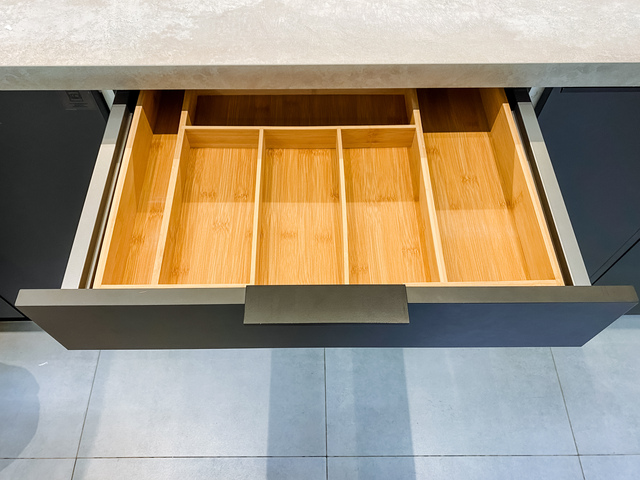
Bamboo organizer sets include multiple interlocking trays that together fill a standard drawer completely. They typically come in configurations for 15-inch or 21-inch drawer widths. Furthermore, the natural material resists warping under typical kitchen humidity levels.
Bamboo sets offer less flexibility than modular plastic systems. The fixed tray dimensions may not align with non-standard drawer sizes. Also, gaps between bamboo pieces can collect small debris over time.
Read More:
- 15 Pot Lid Storage Solutions for Standard Cabinets
- 18 Pantry Storage Ideas for Narrow Spaces That Feel Small
- 14 Ways to Organize Open Shelves in the Kitchen
- 21 Ways to Organize a Small Kitchen on a Budget
Velcro-Backed Containers for Secure Placement
Containers with hook-and-loop adhesive backing attach directly to the drawer floor. They do not slide when the drawer opens or closes rapidly, which makes them useful near the stove or in other high-traffic kitchen areas. This stability suits households where drawers open frequently and quickly.
Confirm the drawer surface is clean and smooth before applying adhesive backing. Residue or surface texture can weaken adhesion over time.
Velcro-backed containers resist repositioning after the adhesive sets. Additionally, they may leave residue when removed, depending on the drawer’s finish.
Nested Container Sets for Flexible Sizing
Nested containers come in graduated sizes that fit inside one another for compact storage when not in use. When deployed in a drawer, the different sizes accommodate varied item types. For example, small containers hold screws or clips, while larger ones hold tape rolls or batteries.
These sets come widely available in plastic and silicone materials. They do not typically interlock, so they may shift inside the drawer. However, a surrounding divider or border piece can prevent that movement.
Drawer Organizer Trays with Integrated Handles
Some organizer trays include a molded grip or recessed handle that allows the user to lift the entire tray out of the drawer. This feature helps when items at the back of the drawer are difficult to reach. As a result, it suits deep drawers with heavy or densely packed contents.
- Trays with handles require extra vertical clearance when lifting
- Not compatible with drawers installed under low-hanging cabinet sections
- Handle placement affects how trays fit side by side
This design adds a retrieval step that may not suit drawers used for quick daily access.
Foam Drawer Liners Cut to Custom Compartment Sizes
Foam drawer liner sheets cut with scissors to create custom-shaped compartments suited to any drawer layout. The foam grips items and prevents sliding. It also cushions tools and protects the drawer’s interior finish.
Foam liners come in rolls or pre-cut sheets across various thicknesses. Thicker foam at 6mm or more provides better grip and structural support. In contrast, thin foam compresses under heavy items and loses its containment function.
Foam does not create vertical walls, so it works best for items that stay stable and do not roll.
Related Post: How to Organize Kitchen Drawers Without Dividers
Rotating Turntable Inserts for Deep or Square Drawers
A small turntable, typically 6–9 inches in diameter, can sit inside a wide utility drawer to simplify access. Rotating access reduces the need to reach across or behind items. This method particularly suits drawers that are deeper front-to-back than they are wide.
Turntables require a flat, smooth drawer floor to spin freely. They do not work effectively in drawers with raised center rails or uneven surfaces. However, standard lazy Susans designed for cabinet use often adapt well to this purpose.
Cord and Cable Management Clips Inside Utility Drawers
Adhesive cable clips attached to the interior side wall of a drawer keep charging cables and cords from tangling. The clips hold the cable end at the drawer edge for quick retrieval. As a result, the cable body coils loosely in the drawer without interfering with other contents.
This method works best when the drawer dedicates a specific section to cables. Mixing cables with loose small items typically eliminates the organization benefit. Additionally, velcro cable ties used alongside clips further reduce tangling.
Small Toolbox Inserts for Hardware-Heavy Drawers
Plastic toolbox tray inserts designed for small tool storage translate directly into kitchen utility drawers. They include molded slots for screwdrivers, pliers, and measuring tape. Furthermore, these inserts typically measure 12–16 inches long and fit standard base cabinet drawers.
Toolbox inserts run deeper than standard kitchen drawer organizers. They require a drawer with at least 3 inches of interior depth. Therefore, they do not suit shallow drawers intended for flatware or linens.
Read More: How to Organize Kitchen Drawers in Small Apartments
Chalkboard Label Inserts for Reconfigurable Sections
Some drawer organizer sets include insert cards with a chalkboard surface that users can erase and update as contents change. This flexibility suits utility drawers where categories shift seasonally or with household changes. Standard chalk or chalk markers both work on this surface, though chalk markers produce more durable labels.
Chalkboard inserts typically consist of card-stock or thin plastic with a coated surface. They sit at the front of each bin or tray section for easy reading. However, this system requires periodic maintenance to keep labels current and legible.
Modular Plastic Grid Systems for Kitchen Utility Drawer Organization
Modular plastic grid systems use interlocking rectangular or square units that snap together. Users can assemble the grid in multiple configurations to match the drawer’s dimensions. Additionally, individual units add or remove easily as organization needs change.
- Units typically measure 2×2 or 2×4 inches per cell
- Systems commonly use a standard snap interface across brands
- Grid height is typically uniform, limiting use in very shallow drawers
This represents one of the most scalable kitchen utility drawer organization systems available. However, it suits irregular drawer dimensions less effectively, where partial units would appear at the edges.
For more helpful tips, check out our organization section.