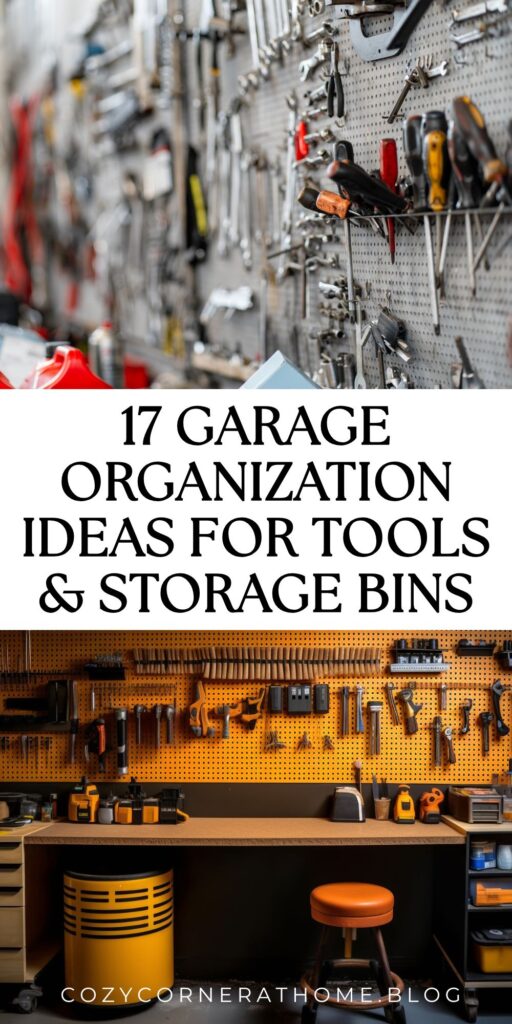
17 Garage Organization Ideas for Tools and Storage Bins
This site contains affiliate links, view the disclosure for more information.
Garage organization ideas solve one of the most persistent storage problems in the home. Most garages collect tools, bins, hardware, and seasonal gear without any system to keep them accessible. Without a deliberate layout, floor space disappears and finding specific items takes longer than it should.
Multiple organization systems are necessary because garages contain different item types. Hand tools, power tools, bulk supplies, and large bins each require different mounting methods, weight ratings, and access heights. One system rarely handles all categories effectively.
This guide covers 17 practical storage methods organized by category: wall systems, overhead racks, freestanding shelving, bin solutions, workbench storage, and floor-level organization. Each method addresses a specific storage type with specific constraints.
Slatwall Panels for Mixed Tool Categories
Slatwall panels accept interchangeable accessories including hooks, bins, shelves, and tool holders. They are available in 4×8-foot sections and can be cut to fit any wall width.
Accessory Types
- Wire baskets for small parts
- Angled shelves for spray bottles
- Flat shelves for cordless tool chargers
- Loop holders for extension cords
Each panel typically supports 50–75 lbs when mounted into studs at standard 16-inch spacing. Exceeding this load rating can cause panel separation from the wall.
Magnetic Tool Strips for Metal Hand Tools
Magnetic strips mount directly to the wall and hold metal tools without hooks or holders. Common placements include above workbenches and along backsplash areas.
Size and Capacity
- Standard strip lengths: 12, 18, and 24 inches
- Holding strength: typically 10–25 lbs per strip depending on magnet grade
- Mounting: wood screws into studs or heavy-duty wall anchors
Magnetic strips do not hold tools with plastic or composite handles where the metal contact point is minimal.
Also Read: 18 Pantry Storage Ideas for Narrow Spaces That Feel Small
Overhead Ceiling Racks for Seasonal Bin Storage
Ceiling-mounted storage racks are effective garage organization ideas for items used infrequently. Holiday bins, camping gear, and sports equipment store well overhead.
Racks attach to ceiling joists using lag screws. Most residential overhead racks are rated for 250–600 lbs total capacity across the platform.
Do not exceed the manufacturer’s rated load. Overloaded ceiling racks can fail and cause serious injury.
Minimum ceiling clearance of 8 feet is recommended so that overhead storage does not interfere with garage door operation or vehicle rooflines.
Ceiling Pulley Systems for Ladders and Kayaks
Pulley systems suspend large items like ladders, kayaks, canoes, and lumber from the ceiling using a rope-and-cam mechanism. Four-point systems distribute weight more evenly than two-point versions.
Most residential pulley systems are rated for 100–200 lbs. Heavier items require purpose-built hoists with rated lift capacities. Standard pulley systems are not suitable for motorized vehicles or equipment with fuel inside.
Read More:
- 21 Ways to Organize a Small Kitchen on a Budget
- How to Organize Kitchen Drawers Without Dividers
- 15 Under-Sink Organization Tips for Pipes That Block Storage
Heavy-Duty Metal Shelving for Large Storage Bins
Freestanding metal shelving holds large storage bins, tool bags, and bulk supply containers. Wire shelving and solid-deck shelving are both widely used in garages.
Capacity Guidelines
- Light-duty units: 200–400 lbs total
- Medium-duty units: 600–1,000 lbs total
- Heavy-duty units: 1,500–4,000 lbs total
Position units against walls to prevent tipping. Units taller than 5 feet should be anchored to the wall at the top shelf bracket.
Solid-deck shelving is preferred over wire shelving when storing small items or bins with open-grid bottoms.
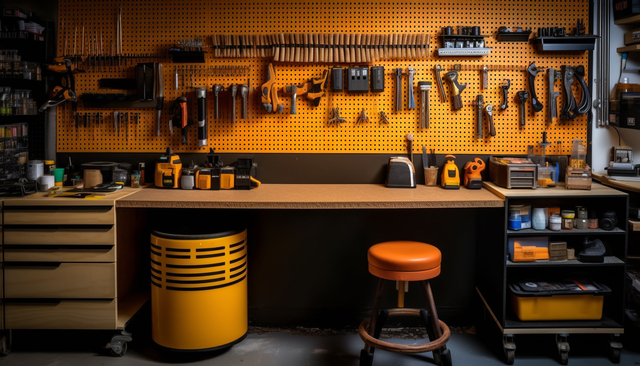
Wall-Mounted Pegboard for Hand Tool Storage

Pegboard is one of the most common garage organization ideas for hand tools. It allows flexible hook placement without permanent tool positions.
Standard pegboard comes in ¼-inch and ⅛-inch thickness. Use ¼-inch for heavier tools like hammers and wrenches. Mount panels at least 1 inch away from the wall surface using spacer blocks to allow hook insertion.
- Hook types: single hooks, double hooks, J-hooks, and looped holders
- Weight limit per hook: typically 5–30 lbs depending on size
- Panel spacing from wall: minimum 1 inch
Pegboard mounted into drywall without stud support cannot hold heavy tools reliably.
Stackable Plastic Storage Bins with Label Systems
Stackable bins keep similar items grouped and accessible without permanent installation. Clear bins allow visual identification without opening each container.
Bin sizes typically range from 6-quart to 64-quart capacity. Heavier contents like hardware and automotive supplies should use smaller bins to keep individual bin weight manageable. Most bin stacks should not exceed 4–5 units high without shelf support.
Label each bin on the front face and lid for access from multiple angles.
Rolling Tool Chests for Portable Tool Access
Rolling tool boxes allow tool storage to move with the work area. Most units are designed as single-compartment or multi-tray boxes mounted on casters, making them easier to reposition than fixed cabinet systems.
Capacity Notes
- Tray compartments: typically 20–50 lbs per tray
- Interior base compartment: typically 75–150 lbs
- Box total: varies by unit, commonly 200–600 lbs
Tool boxes on smooth concrete roll easily. Garage floors with significant cracks or uneven surfaces can limit caster movement and cause lid alignment issues over time.
Wall-Mounted Cabinet Systems for Enclosed Storage
Wall-mounted cabinets keep tools and supplies out of sight and protected from dust. They work well for chemicals, paint supplies, and precision tools that need a consistent environment.
Cabinet depth typically ranges from 12 to 16 inches. Do not mount cabinets into drywall without hitting studs or using rated toggle anchors rated for the loaded cabinet weight. Most wall cabinets with tools inside weigh 50–150 lbs fully loaded.
Freestanding Tall Storage Cabinets for Bulk Items
Tall freestanding cabinets accommodate long-handled tools like rakes, shovels, and brooms alongside shelved bins. They typically range from 6 to 7 feet tall with adjustable interior shelving.
Units should be anchored to wall studs at the top if placed in areas with foot traffic. Doors with magnetic closures keep contents contained but do not lock, which limits use for hazardous chemicals unless the unit includes a locking mechanism.
Corner Shelving Units for Underused Wall Angles
Corner spaces in garages are often left empty. L-shaped or triangular corner shelving units fit into 90-degree wall angles and provide additional bin or tool storage without consuming primary wall space.
Most corner shelf units are freestanding and rated for 200–400 lbs. They are best suited for lighter bins and frequently used supplies rather than heavy tool storage.
Wall-Mounted Bike Storage Hooks
Vertical bike hooks mount into wall studs and hold bikes by one or both wheels. Horizontal hooks hold bikes parallel to the wall, requiring more linear wall space but less vertical clearance.
Hook weight ratings typically range from 30–75 lbs per hook. Use stud-mounted installation for any bike over 30 lbs. Drywall anchor installations are only appropriate for lightweight children’s bikes.
Lumber and Long-Item Wall Racks
Horizontal arm racks hold lumber, pipe, conduit, and long-handled tools. Arms extend from a vertical wall-mounted rail and can often be adjusted in height.
Arm Load Limits
- Standard arms: 50–100 lbs per arm
- Heavy-duty arms: up to 200 lbs per arm
Keep lumber stored flat to prevent warping. Racks should be positioned clear of garage door tracks and vehicle door swing paths.
Read More: 7 Deep Drawer Organization Ideas to Reduce clutter
Garage Organization Ideas Using Bin Labeling Systems
Bin labeling improves retrieval time across all storage methods. Labels applied to the front face and lid allow identification from multiple positions and angles.
Label materials include adhesive paper, label maker tape, and chalkboard paint panels. Adhesive paper labels degrade in high-humidity garages. Label maker tape with UV-resistant coating lasts longer in uninsulated garage environments.
Workbench Drawer Organizers for Small Parts
Drawer organizers divide workbench drawers into compartments for screws, nails, bolts, and small hardware. Adjustable divider systems allow compartment sizing based on the parts stored.
Plastic organizers are lightweight and easy to clean. Metal organizers handle heavier parts without flexing under load. Drawer organizers do not increase drawer weight capacity — the drawer’s rated load still applies to the total contents.
Pegboard Bin Attachments for Small Parts Access
Small plastic bins clip directly onto pegboard hooks and hold screws, drill bits, sandpaper, and similar small items. They keep small parts visible and accessible without dedicated cabinet space.
Bin sizes typically range from 1-cup to 1-quart capacity. Each loaded bin adds weight to the pegboard hook system. Check total hook load against pegboard panel ratings when using multiple bins on a single panel.
Floor-Level Storage for Heavy Equipment and Bins
Floor-level storage keeps the heaviest items — floor jacks, compressors, large power tools, and bulk material bins — at ground level where weight is not a structural concern.
Use floor dollies with locking casters to make heavy equipment movable without lifting. Dollies rated for 500–1,000 lbs are available for floor jacks and compressors. Locking casters prevent unintended movement on sloped garage floors.
Floors with significant oil staining or moisture intrusion can affect caster performance and bin stability over time. Sealed or painted concrete surfaces typically provide more consistent contact for rolling storage.
For more helpful tips, check out our organization section.